



What Are Tabriz Oriental & Persian Rugs with ≤ 30 Raj?
Tabriz rugs with a knot density of up to 30 Raj are hand‑knotted by experienced artisans using traditional techniques (Senneh or Turkish knot). High‑quality new wool is predominantly used—often combined with silk highlights. The motifs and medallions of these rugs appear bold, harmonious and clearly structured thanks to their moderate knot density. They combine decorative and practical qualities and are appreciated both as durable everyday rugs and as collectibles. Their craftsmanship is intended to endure for generations. Classic Tabriz Persian rugs are hand‑knotted in Iran/Persia, yet high‑quality hand‑knotted versions are also produced today in China and India.
What Does “Raj” Mean in Tabriz Rugs? How Is Raj Calculated?
Raj is the traditional unit used to measure the knot density of Tabriz rugs. It specifies how many knots are placed side‑by‑side across 7 cm of width. The higher the Raj value, the higher the knot density per square metre—and the finer and more detailed the pattern becomes. To determine the Raj value, measure 7 cm on the rug’s back and count the knot groups along this width (e.g. 30 Raj = 30 knots over 7 cm). Rugs up to 30 Raj typically feature 120,000 to 400,000 knots per square metre—producing robust Persian rugs with bold, clearly defined motifs and a pleasantly textured pile. Raj is a key reference for assessing quality and price.
History & Geographic Origin of Tabriz Rugs
Tabriz is one of the most important centres of Oriental carpet art. The historic city lies in northwest Iran, in the province of East Azerbaijan, and has been an international trading hub for rugs since the Middle Ages. Influenced by Persian dynasties, the Ottomans and neighbouring Russia, Tabriz developed a wide variety of motifs, innovative designs and refined weaving techniques. Tabriz rugs are famous for their medallions, artistic arabesques and complex borders—widely recognised as symbols of Persian culture. Today they remain sought‑after classics, including in Chinese (Sino Tabriz) and Indian (Indo Tabriz) reinterpretations.
Manufacturing Process – Traditional Craftsmanship from Persia, India & China
1.) Material Selection & Dyeing:
Only high‑quality new wool—sometimes combined with silk—is chosen for Tabriz rugs. To ensure durability and characteristic lustre, the raw yarns are first hand‑washed and hand‑spun. Dyeing may be carried out with traditional natural dyes, prized for their lightfastness and harmonious tones, or with modern pigments that allow for a wider range of colours. After dyeing, the yarn is carefully dried and prepared for the loom.
2.) Knotting on the Loom:
The knotting process takes place on a vertical loom. Artisans work with detailed pattern charts (cartoons) featuring medallions, floral fields, blossoms and vine motifs—or, in many traditional workshops, from memory. With up to 30 Raj (30 knots over 7 cm), the moderate knot density produces distinctive, well‑defined motifs and a textured, full pile. After knotting is complete, the rug is washed, dried flat, and its pile is meticulously sheared to reveal the pattern crisply and evenly.
3.) Finishing & Quality Control:
The final finishing stage is essential for the quality and value of a Tabriz rug. Fringes and side bindings are reinforced and refined by hand. Hand‑shearing enhances motif clarity and the tactile feel of the pile. A rigorous inspection ensures that only visually and technically flawless rugs are approved for sale—guaranteeing an authentic, high‑quality one‑of‑a‑kind piece.
Pattern Variety & Colour Palette of Tabriz Rugs up to 30 Raj
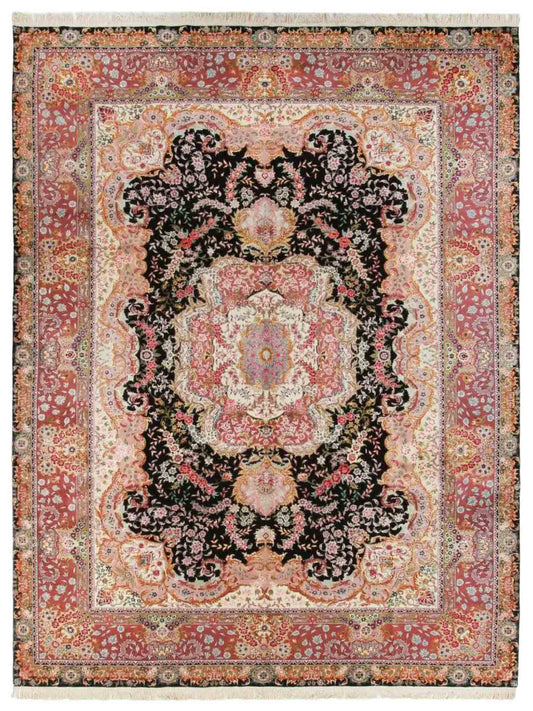
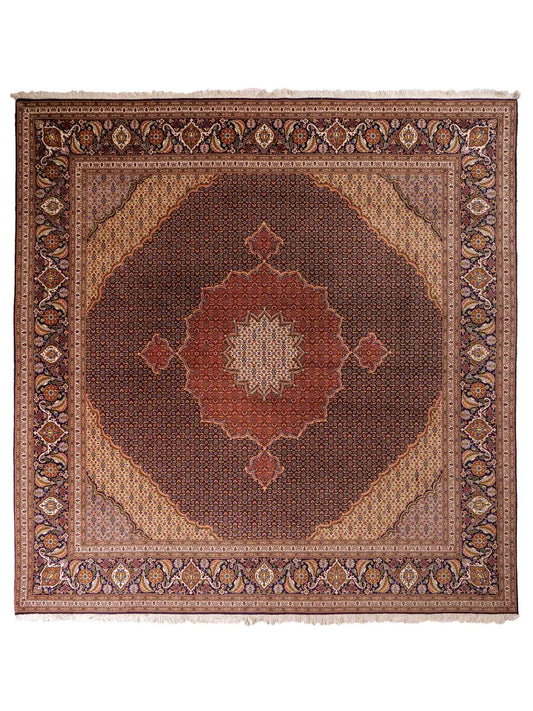
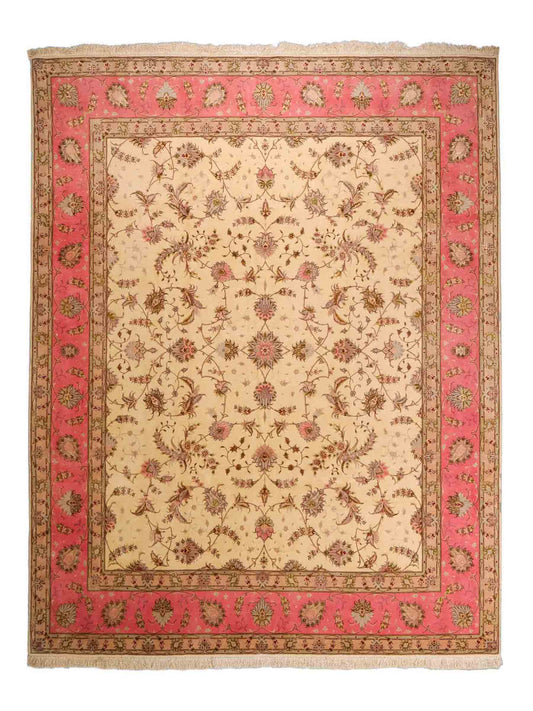
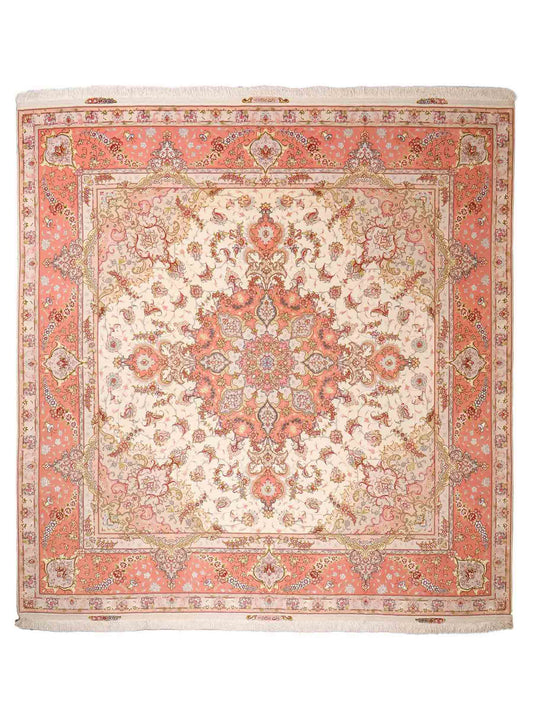
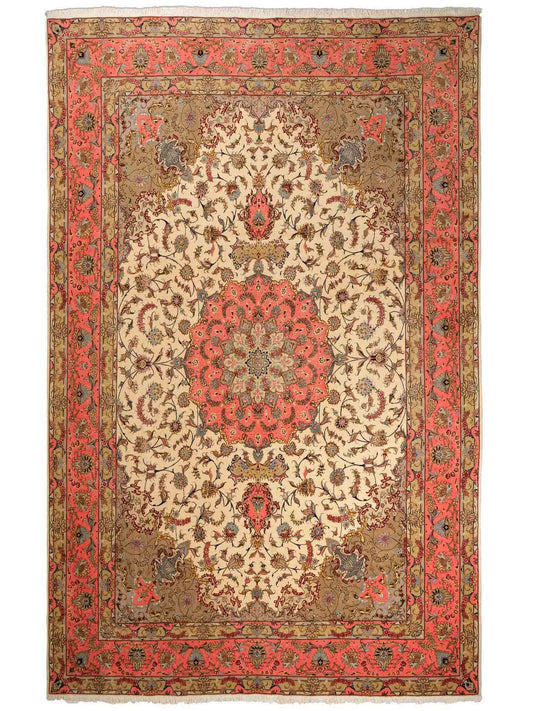
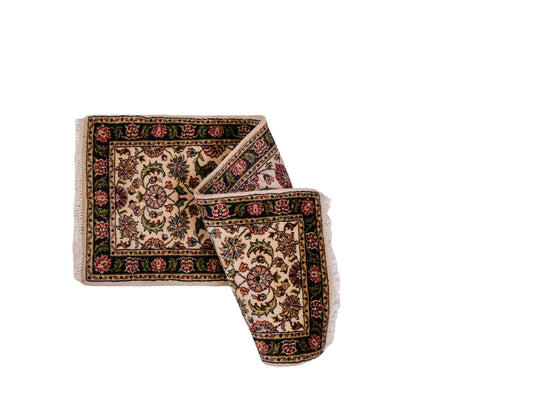
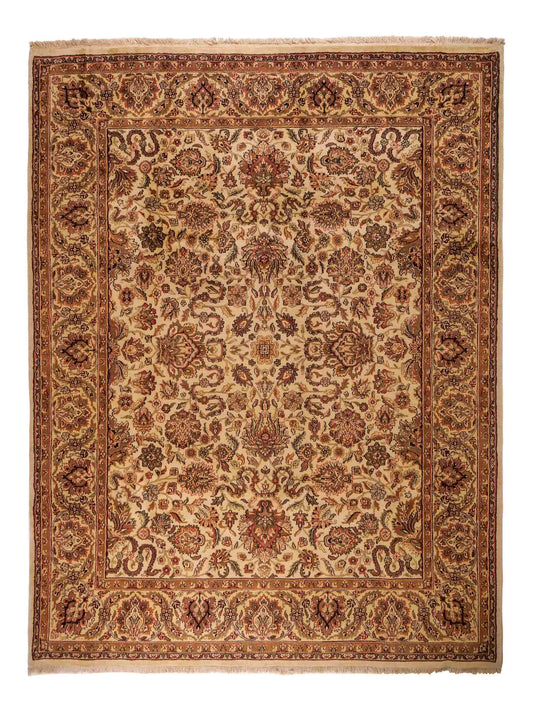
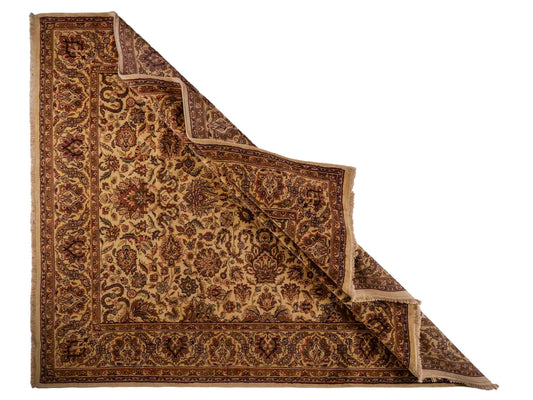
Tabriz rugs with up to 30 Raj offer a wide range of motifs and rich colour palettes. Large central medallions often serve as the focal point, adding depth and striking contrast. Field patterns and allover designs with floral motifs, palmettes or symbolic ornaments draw from both Persian and Indo‑Chinese weaving traditions. Borders are often elaborate—featuring floral or geometric designs, animal depictions, flowing vines or imaginative details. Colour palettes include classic reds and blues, complemented by ivory, gold, brown, sand, orange and green. Depending on regional tradition, you’ll also find pastel tones, lively multicolour compositions or the characteristic “abrash” shading that gives each rug its unique individuality.
Choosing the Right Size for Tabriz Rugs up to 30 Raj
A Tabriz rug reveals its full beauty when perfectly matched to the space. In smaller rooms, hallways or reading nooks, compact formats such as 120×80 cm or 150×100 cm create warm and expressive accents. A 170×120 cm rug is ideal for cosy retreats or intimate zones.
Medium sizes—200×150 cm, 240×170 cm or 270×180 cm—anchor living or dining rooms with harmony and sophistication. For expansive areas such as salons, lofts or grand entrances, larger formats such as 300×200 cm, 350×250 cm or even 400×300 cm provide impressive design possibilities.
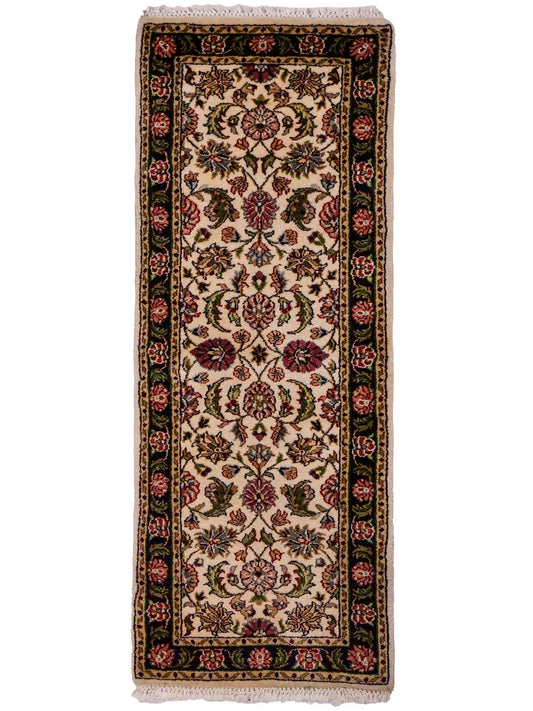
Runners are well‑suited to hallways or transitional spaces. Popular sizes such as 250×70 cm or 300×80 cm guide the eye gracefully and add warmth. For an artistic “layered” interior look, combine several smaller rugs patchwork‑style.
When placing your rug, allow the front legs of sofas or chairs to rest slightly on the rug—this visually connects the room and creates balance and inviting cohesion.
Explore more size guidance in our Rug Size Guide.
Interior & Styling Tips for Selecting Your New Tabriz Rug
A Tabriz rug with up to 30 Raj blends tradition with surprising versatility—adding character and warmth to any room. Pair it with classic wood furniture and Oriental accessories for timeless elegance. Or embrace contrast: with leather, concrete or soft velvets, the rug becomes a focal point that brings depth and harmony to modern spaces.
Even in minimalist, urban or vintage interiors, a Tabriz rug creates a stylish visual anchor. Large formats act as a refined centrepiece, while combining smaller rugs in layered arrangements adds dimension and comfort.
Accentuate the rug with selected artworks, patterned cushions or glass display pieces to highlight its ornamentation and vibrant colours. Treat yourself to an authentic work of craftsmanship—and let your home express your personality through a true Tabriz original.
Key Tabriz Rugs Compared
| Provenance / Type | Material | Knot Density | Fineness Grade | Special Features |
|---|---|---|---|---|
| Tabriz up to 30 Raj Oriental & Persian Rugs (Iran/Persia, India) | High‑quality sheep’s wool, some silk | 200,000–400,000 knots/m² | Standard to fine | Durable, classic motifs, accessible entry‑level choice |
| Tabriz 40–50 Raj Oriental & Persian Rugs (Iran/Persia, China, India) | Sheep’s wool with silk accents | 400,000–600,000 knots/m² | Fine to very fine | Refined motifs, elegant contours, high craftsmanship |
| Tabriz 60–70 Raj Oriental & Persian Rugs (Iran/Persia, China) | Cork wool with high silk content | 600,000–900,000 knots/m² | Very fine to super fine | Exquisite details, delicate ornamentation, luxury category |
| Tabriz 80–90 Raj Oriental & Persian Rugs (Iran/Persia, China) | Finest cork wool & natural silk | 900,000–1,200,000+ knots/m² | Super fine to ultra fine | Rarities, miniature‑level precision, outstanding craftsmanship |
| Signed Tabriz Rugs (Iran/Persia, China) | Finest cork wool & natural silk | 400,000–1,200,000+ knots/m² | Fine to ultra fine | Master signatures, atelier pieces, collector‑grade quality |
| Tabriz Art Pictorial Rugs (Iran/Persia, China) | Finest cork wool & natural silk | 300,000–1,200,000+ knots/m² | Fine to ultra fine | Pictorial artworks in woven form, highly artistic execution |
| Sino Tabriz Oriental Rugs (China) | Fine sheep’s wool with high silk content | 300,000–900,000+ knots/m² | Fine to super fine | Excellent workmanship, exceptional value in luxury segment |
| Indo Tabriz Oriental Rugs (India) | Fine wool, sometimes viscose blend | 100,000–500,000 knots/m² | Coarse to fine | Clean workmanship, durable, faithful to Tabriz tradition |
| Tabriz Mahi Oriental & Persian Rugs (Iran/Persia, India) | High‑quality wool with silk accents | 100,000–600,000 knots/m² | Coarse to fine | Fish motif (Mahi), timeless Persian classic |
FAQ – Frequently Asked Questions about Tabriz Rugs up to 30 Raj
What does “≤ 30 Raj” mean in a Tabriz rug?
Raj measures knot density, specifying how many knots lie across 7 cm of width. A value of ≤ 30 Raj means up to 30 knots are knotted over 7 cm—typically 120,000 to 400,000 knots per square metre. Such rugs are robust, feature bold motifs and represent enduring traditional craftsmanship.
How do I properly care for a Tabriz rug up to 30 Raj?
Vacuum your Tabriz rug gently (dry only), avoid moisture and long‑term direct sunlight. For deep cleaning, always consult professional rug specialists. Learn more about carpet care.
Which are better—antique Tabriz rugs or new rugs of this knot group?
Both are authentic and have their own appeal: antique or semi‑antique Tabriz rugs captivate with their unique charm and patina—highly valued by collectors. New rugs in this knot group offer strong colours, durability and a wide range of designs. The right choice depends entirely on your personal taste and interior style.
Do Tabriz ≤ 30 Raj rugs suit modern interiors?
Absolutely. Tabriz rugs up to 30 Raj create either a striking stylistic contrast or a bold design statement in modern spaces—while also pairing beautifully with classic or wood‑accented interiors.
Do all Tabriz rugs come with a certificate of authenticity?
Yes. At JUPITER Intl, every handmade rug is accompanied by a certificate detailing its provenance and materials. Learn more about our certificate of authenticity.
Quality, Price & Service by JUPITER Intl
- Each of our Tabriz rugs up to 30 Raj is a hand‑knotted original, selected for craftsmanship, quality and design
- Transparent provenance: all handmade rugs include a certificate of authenticity
- Fair prices directly from Khademi—no middlemen or misleading “retail prices”
- A wide selection: from exclusive Qom silk rugs and exquisite Nain Persian rugs to modern Ziegler Oriental rugs, handwoven kilims and premium machine‑made rugs
- Personal advice on provenance, size, materials and style
- Secure checkout, 31‑day return policy & free returns for your complete satisfaction
Personal Consultation at JUPITER Intl
Looking for the perfect 30 Raj Tabriz rug, a specific provenance, size or design? Our experienced team is delighted to support you—from professional styling advice to sourcing exceptional individual pieces. Contact us by phone or email, or combine your visit with a tour of our showroom in Hamburg’s historic Speicherstadt—part of the UNESCO World Heritage Site—where history, craftsmanship and timeless design come together.
More Information & Links
- Design Classic: Tabriz Rugs
- Countries of Origin: Iran – Persian Perfection from a Master's Hand
- Countries of Origin: China – Expression of a Rich Culture
- Countries of Origin: India – Colour, Diversity and Tradition
- Carpet Guide: How Do I Properly Care for Hand-Knotted Rugs?
- Carpet Guide: What to Consider When Choosing Rug Size
- Carpet Guide: How to Identify Hand-Knotted Rugs
- Carpet Guide: How to Calculate the Knot Density of a Rug
- Carpet Guide: Difference Between Rug Knot Types
- Carpet Guide: How Sustainable Are Hand-Knotted Rugs?
- Carpet Guide: Are Hand-Knotted Rugs a Good Investment?
- Certificate of Authenticity: Your Guarantee for Quality and Authenticity