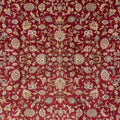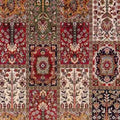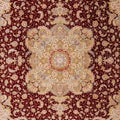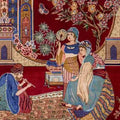

Chinese rugs are regarded as culturally significant works of textile art, merging tradition, aesthetic refinement, and symbolic motifs. Their designs range from mythological figures and nature‑inspired imagery to clean geometric compositions — expressions of a visual culture that spans millennia.
Chinese Rugs: Key Facts at a Glance
- A synthesis of craftsmanship, symbolism, and traditional culture
- Typical motifs: dragon, phoenix, lotus, peacock
- Materials: wool, silk, cotton
- Distinct regional knotting techniques and styles
- Major centers: Ningxia, Shandong, Xinjiang, Henan, Sichuan
- Each rug carries historical and cultural narratives
Discover Our Chinese Rugs – Explore the Collection
History & Tradition of Chinese Rugs
The earliest Chinese rugs trace back to nomadic cultures of the northwestern steppes. From the Ming and Qing dynasties onward, a distinct Chinese rug tradition emerged — defined by refined design aesthetics, premium natural materials, and sophisticated symbolic language.
During this era, regional weaving centers developed stylistic identities — such as those in Ningxia or Shandong — that remain recognizable today. Their artistic motifs and balanced color compositions have been passed down through generations.
Symbolism & Designs in Chinese Rugs
Chinese rugs are rich in motifs that express philosophical, religious, or mythological meanings:
- Lotus blossoms: purity and renewal
- Dragons: protection, strength, and good fortune
- Phoenixes: transformation and harmony
- Peacocks: dignity and beauty
These motifs are often integrated into balanced compositions featuring cloud bands, medallions, tendrils, or stylized natural forms. Colors such as blue, gold, red, and yellow lend Chinese rugs their strong visual identity.
High‑Quality Natural Materials
Traditional Chinese rugs are woven from natural fibers:
- Wool: durable, warm, and full of character
- Silk: ideal for fine, artistic motifs with luminous sheen
- Cotton: commonly used for the foundation
The Art of Chinese Knotting
Depending on the region, different techniques such as the asymmetrical (Persian) knot or symmetrical (Turkish) knot are used. Each method influences the rug’s fineness, texture, and visual rhythm.
Many artisans begin their training early in life, contributing to the remarkable precision found in traditional Chinese rugs.
Major Rug‑Making Regions of China
| Region | Signature Characteristics | Designs & Motifs | Colors & Highlights |
|---|---|---|---|
| Ningxia | Robust wool rugs | Geometric patterns, medallions | Blue, red, yellow; deeply traditional visual language |
| Shandong | Fine silk rugs | Mythological scenes, delicate detailing | Light tones, silky sheen |
| Xinjiang | Turkmen influences, durable construction | Strong geometries, stylized florals | Intense hues of red, blue, green |
| Henan | High‑pile wool rugs | Dragons, medallions, floral scrolls | Red, gold, blue; extremely long‑lasting |
| Sichuan | Flatweaves & knotted rugs | Floral motifs, clouds, pagodas | Colorful tones, Buddhist symbolism |
Care & Preservation
- Avoid direct sunlight
- Use mild cleaning agents
- Rotate occasionally
Further guidance is available in our article How Do I Properly Care for Hand‑Knotted Rugs?
For insights into long‑term value, see Are Hand‑Knotted Rugs a Good Investment?
Checklist: How to Identify a High‑Quality Chinese Rug
- Hand‑knotted structure with characteristic irregularities
- Natural materials such as wool or silk
- Clearly defined traditional motifs (dragon, lotus, phoenix, etc.)
- Harmonious colors without artificial shine
- Recognizable regional design traits
- Recommended: certificate of authenticity
FAQ – Chinese Rugs
What Makes Chinese Rugs Unique?
► Their expressive symbolic motifs, time‑honored knotting techniques, and cultural depth.
What Is the Significance of Dragons and Phoenixes?
► Dragons represent strength, luck, and protection; phoenixes symbolize renewal and harmony — central motifs in Chinese visual culture.
How Can I Identify Handmade Chinese Rugs?
► By visible knot structures, a well‑defined pattern on the back, and natural, finely nuanced irregularities.
How Should Chinese Rugs Be Cleaned?
► Vacuum gently, avoid direct sunlight, and have high‑quality pieces cleaned professionally.
Conclusion
Chinese rugs combine expressive symbolism, cultivated color harmonies, and meticulous craftsmanship. Their historical motifs range from mythological figures to precise geometric arrangements. Whether interpreted traditionally or in a contemporary interior, they bring cultural depth and timeless aesthetics to any space.