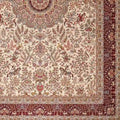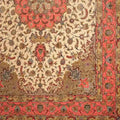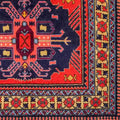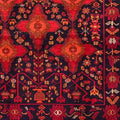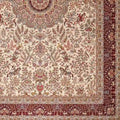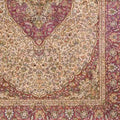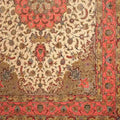

Hand‑knotted rugs are masterpieces of textile art. The knotting technique determines appearance, structure, fineness and durability — and gives each rug its own identity. This guide introduces the essential knotting methods, explains their distinctiveness and shows how to identify them.
1. Persian Knot (Senneh Knot)
The Persian or Senneh knot — also known as the asymmetric knot — is one of the finest knotting techniques. It allows highly detailed patterns and very high knot densities. The yarn is looped asymmetrically around two warp threads, producing a slightly offset knot structure. This technique is typical of Iran (e.g., Tabriz, Isfahan, Qom) as well as parts of the Caucasus and India.
2. Turkish Knot (Gördes Knot)
The Turkish knot — symmetrical and firm — is wrapped evenly around two warp threads, creating a robust and resilient structure. It is characteristic of Turkish rugs as well as many Afghan, Caucasian and Central Asian pieces. Patterns are often more geometric, and the rugs highly durable — ideal for areas with frequent use.
3. Chinese Knot
Chinese rugs often use distinct knotting methods, including variations of the Senneh knot and regionally developed techniques. They are known for thicker piles and particularly clear pattern definition. Fine Chinese silk rugs may reach exceptionally high knot densities.
4. Afghan Knot
The Afghan knot is typically a symmetrical variation with a dense, compact pile. It resembles the Turkish knot in structure and is common in Afghan and Turkmen rugs. Designs are often geometric, with bold colors and a robust aesthetic.
5. Central Asian Knot Forms
Across Central Asia, numerous knotting variations exist — often blends or regional evolutions of Persian and Turkish techniques. These rugs frequently feature tribal motifs, earthy palettes and compact, durable structures.
6. Note on Navajo Weaving
The often-mentioned “Navajo knot” is not a knotting technique. Navajo rugs are not knotted but woven — using a distinct binding method that relies entirely on interlacing, without knots. They represent a separate textile art tradition and cannot be compared with classic knotted rugs.
FAQ – Knotting Techniques in Hand‑Knotted Rugs
Which Knotting Technique Is the Finest?
► The Persian (asymmetric) knot allows the highest fineness and most detailed motifs — though the overall craftsmanship context always matters.
Which Knot Is Best for High‑Traffic Spaces?
► Symmetrical knots like the Turkish or Afghan knot create dense, durable structures — ideal for hallways or living rooms.
How Can I Identify the Knotting Technique in My Rug?
► By examining the reverse side: the way knots wrap around the warp threads reveals the technique. If in doubt, we’re happy to assist personally.
Conclusion
Knotting techniques define the look, fineness and durability of hand‑knotted rugs. Whether Persian, Turkish or regionally rooted — every technique tells its own story. Knowing their differences helps you assess a rug’s provenance, quality and character with greater confidence.